A sword, a cloak, a man in the cold. For about a thousand years artists have been asked to show Martin, and almost all of them chose the same moment at the gate of Amiens. What changed is everything around it.
What the painters added
Sulpicius tells the scene in a few lines (Life, ch. 3). He mentions a sword, a military cloak and bystanders who laughed. He mentions no horse and gives the cloak no colour.
The horse is the painters’ work, and so is the colour: red most often, but green at Chartres and for El Greco. Once the horse was in the picture it stayed, and it is now how most people imagine the story. The works below are in order of date.

c. 561
At the head of the martyrs
Mosaic · Sant’Apollinare Nuovo, Ravenna
One of the oldest pictures of Martin has no horse, no sword and no beggar. He leads a procession of twenty-six martyrs towards Christ, the only one in a dark cloak among men in white. Martin was not a martyr. He stands first because in 561 the church, built for an Arian king, was rededicated to him, a known opponent of the Arians.

12th century
The altar frontal of Puigbò
Painted wood · Museu Episcopal, Vic
A painted panel from the front of an altar in a mountain parish of Catalonia whose patron is Martin. Around Christ, four small scenes tell the life: the cloak, the raising of a dead man, Martin’s death, and two angels carrying his soul away. The horse is already there.

early 13th century
The rider of Lucca
Stone · Cathedral of San Martino, Lucca
Made for the front of the cathedral, where it stood on two brackets above the portico. In 1946 a copy took its place outside and the original was brought indoors. Martin looks at neither the beggar nor his sword; he stares straight ahead. Nobody knows who carved it.

c. 1215–1225
The Saint Martin window
Stained glass · Chartres Cathedral
One panel of a window almost nine metres tall that tells the whole life in glass. It was paid for by a guild of craftsmen, who had themselves shown at work in the lowest panels. Here the cloak is green.

c. 1240
The Bassenheim Rider
Attributed to the Naumburg Master · St Martin’s Church, Bassenheim
Carved for the cathedral of Mainz, which is dedicated to Martin. When the screen it belonged to was pulled down in 1683, a canon took the relief home to his family’s village near Koblenz. It hung there unrecognised until 1935, when an art historian saw whose hand it was. The horse’s head and the beggar’s arm break out of the frame.

c. 1312–1318
Saint Martin divides his cloak
Simone Martini · Lower Basilica of San Francesco, Assisi
The first of ten scenes that cover a whole chapel. A cardinal whose church in Rome was dedicated to Martin paid 600 gold florins for it in March 1312, died that October, and never saw the paintings. They are neither signed nor dated; the attribution to Simone Martini rests on style.

c. 1312–1318
Saint Martin renounces his weapons
Simone Martini · Lower Basilica of San Francesco, Assisi
The refusal at Worms, from the same chapel. The emperor sits among his tents and the enemy waits behind the rocks. Martin walks towards them holding a cross. The banners carry the heraldry of the painter’s own century, not of Martin’s.

c. 1452–1460
The Charity of Saint Martin
Jean Fouquet · Musée du Louvre, Paris
A page from a prayer book made for the treasurer of the king of France. Fouquet, who was from Tours, moved the scene to a French town of his own day, with a bridge and a troop of riders looking on. The book was later cut up so that each painting could be sold as a picture. This leaf reached the Louvre in 1889.

c. 1490
Saint Martin and the Beggar
Unknown Hungarian painter · Hungarian National Gallery, Budapest
A wing from an altarpiece whose church is no longer known, painted in the country where Martin was born. The soldier wears a crown-like hat and a halo, and the beggar, on the ground, takes hold of the cloak while it is still being cut.

1503–1508
The Great Hours of Anne of Brittany
Jean Bourdichon · Bibliothèque nationale de France, Paris
Painted for Anne of Brittany, twice queen of France, by a pupil of Fouquet. The book has 49 full-page pictures framed like panel paintings, and Martin is there among the saints of Touraine. His armour is gold and the cloak is violet.

c. 1520
The Montpezat tapestries
Flemish workshop · Church of Saint-Martin, Montpezat-de-Quercy
Five tapestries of the life of Martin, given by a bishop of Montauban. They still hang in the choir of the church they were woven for, about five hundred years later, which is rare for tapestries. Each scene has its caption in French verse along the top.

1597–1599
Saint Martin and the Beggar
El Greco · National Gallery of Art, Washington
Painted for a chapel in Toledo whose founder was named Martín. It hung there for about three hundred years before it was sold to an American collector in the early 1900s. Martin is a young Spanish nobleman in the armour of El Greco’s day, and the cloak is green.

c. 1618–1621
Saint Martin Dividing his Cloak
Anthony van Dyck · Sint-Martinuskerk, Zaventem
An early work, painted when Van Dyck was about twenty and working in the studio of Rubens. It was installed in the parish church of Zaventem, near Brussels, in 1621. In 1794 the French carried it off to the Louvre; it came back after 1815 and hangs in the church today.

1630
Saint Martin Healing a Possessed Man
Jacob Jordaens · Royal Museums of Fine Arts of Belgium, Brussels
More than four metres high, signed and dated, and for once not the cloak. Martin is the bishop and exorcist of the later chapters, calm in gold vestments while several men struggle to hold the sick man down.

1733–1735
Saint Martin and the Beggar
Georg Raphael Donner · St Martin’s Cathedral, Bratislava
Cast in lead for the high altar of the cathedral where the kings of Hungary were crowned. Donner dressed the Roman soldier as a Hungarian hussar. The altar is gone; the rider and the beggar stayed.

1889
The statue on the dome
Jean-Baptiste Hugues · Basilica of Saint Martin, Tours
Over his tomb Martin is the bishop, not the soldier: a bronze figure more than four metres high, blessing the city. When it was taken down for repair in 2014, a lead box was found inside the right arm holding a bone attributed to Martin, placed there in 1889. The statue went back up in October 2016.
And now
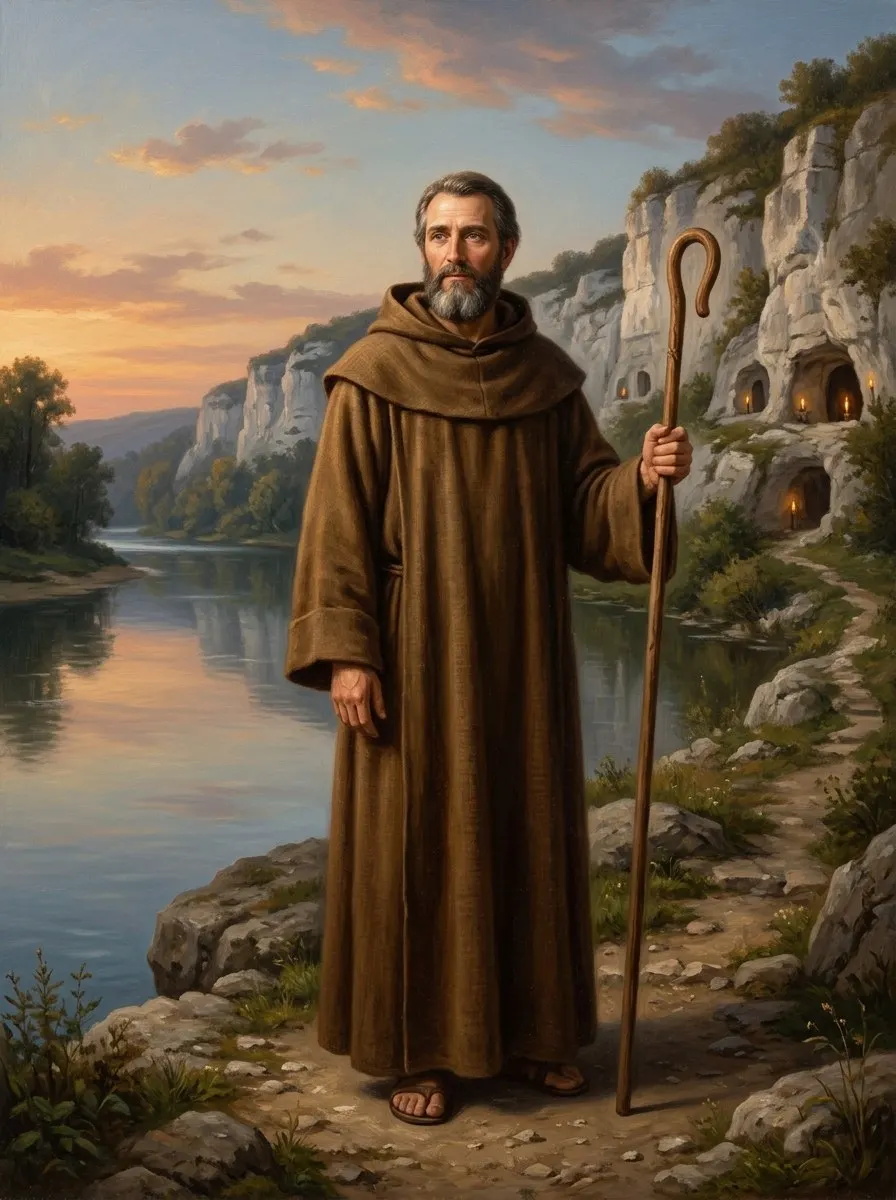
The paintings made for this edition, which open each page of this site, are the newest in that line. They show the same scenes, and a few that the old masters left alone: the kidnapping at Tours, the hut at Marmoutier, the Devil dressed in purple.
Keep reading
The man who said no →Patron of what? →Fact or legend? →After the book → Get the book, free
Dates, attributions and locations follow the museums and churches that hold the works, and Wikimedia Commons. Each picture links to its source. Found a mistake? Tell us
Photographs (16)
- Detail of a gold-ground mosaic frieze of haloed saints carrying crowns, with Saint Martin in a dark cloak at the head of the line beside Saint Lawrence in gold. — Marie Thérèse Hébert & Jean Robert Thibault, CC BY-SA 2.0, Wikimedia Commons
- Romanesque painted wooden altar frontal with Christ in the centre and four small scenes from the life of Saint Martin, including Martin on horseback cutting his cloak for a poor man. — Ángel M. Felicísimo from Mérida, España, CC BY 2.0, Wikimedia Commons
- Medieval limestone sculpture group of Saint Martin on horseback cutting his cloak with a sword while a beggar stands beside the horse. — Sailko, CC BY 3.0, Wikimedia Commons
- Stained-glass panel on a blue ground showing Saint Martin on horseback cutting his cloak for a beggar. — MOSSOT, CC BY-SA 3.0, Wikimedia Commons
- Early Gothic sandstone relief of Saint Martin on horseback turning in the saddle to cut his cloak, which a half-naked beggar grasps. — Spurzem - Lothar Spurzem, CC BY-SA 2.0 de, Wikimedia Commons
- Fresco of the young Saint Martin on horseback cutting his cloak with his sword for a beggar. — Simone Martini, Public domain, Wikimedia Commons
- Fresco of Saint Martin in a military camp holding a cross and turning from the seated emperor towards the enemy army. — Simone Martini, Public domain, Wikimedia Commons
- Manuscript miniature of Saint Martin on horseback among mounted soldiers in a medieval town, cutting his cloak for a beggar. — Jean Fouquet, Public domain, Wikimedia Commons
- Late Gothic panel painting of Saint Martin on horseback cutting his cloak with a sword for a beggar. — Unknown Hungarian painter, c. 1490, Public domain, Wikimedia Commons
- Full-page Renaissance miniature showing Saint Martin as a young horseman cutting his cloak in two for a beggar. — Jean Bourdichon, Public domain, Wikimedia Commons
- Part of an early 16th-century Flemish tapestry of the life of Saint Martin hanging in the choir of the church of Montpezat-de-Quercy. — MOSSOT, CC BY-SA 3.0, Wikimedia Commons
- Tall painting of a young Saint Martin in armour on a white horse, cutting his cloak for a naked, elongated beggar standing beside him. — El Greco (Domenikos Theotokopoulos), CC0, Wikimedia Commons
- Baroque painting of Saint Martin on a grey-white horse cutting his red cloak with a sword for half-naked beggars on the ground. — Anthony van Dyck, Public domain, Wikimedia Commons
- Large crowded Baroque altarpiece in which Saint Martin as a bishop faces a struggling possessed man held by several men. — Jacob Jordaens (photograph: Rvalette), Public domain, Wikimedia Commons
- Baroque sculpture group of Saint Martin on horseback, dressed as a Hungarian hussar, cutting his cloak for a beggar. — Ondraness, CC BY-SA 4.0, Wikimedia Commons
- Bronze statue of Saint Martin as a bishop standing on top of the dome of the Basilica of Saint-Martin in Tours. — ZohaStel, CC BY-SA 3.0, Wikimedia Commons