Martin is remembered for giving something away. His biographer also records the times he refused: as a soldier, in front of an army, and as a bishop, in front of an emperor. The first made his name. The second failed, and he never forgot it.
Worms: the soldier who would not fight
The scene is in chapter 4 of the Life. The Caesar Julian has gathered the army near Worms, on the Rhine, and is handing out a bonus before battle, man by man. When Martin’s turn comes he refuses the money and asks to be discharged.
Julian calls him a coward, afraid of the next day’s battle. Martin answers that he will stand in front of the line in the morning without shield or helmet. He is locked up overnight so that he cannot back out. The next day, Sulpicius says, the enemy sent envoys and surrendered.
Historians are careful here. Sulpicius is the only source, he wrote some forty years later, and ancient biographers composed speeches for their heroes. The scene is usually dated to 356 or 357, which does not fit easily with the other dates of Martin’s life.
Until now I have served you as a soldier. Let me now be a soldier of God. I am a soldier of Christ: I am not allowed to fight.
Trier: the bishop who argued for his opponents’ lives
About thirty years later Martin was bishop of Tours. In Spain a rich and learned ascetic named Priscillian had gathered a strict following and been made bishop of Ávila. Other bishops accused him of heresy and of sorcery. In 384 a council at Bordeaux was to judge him. Priscillian appealed instead to the emperor, Magnus Maximus, at Trier, and two bishops, Ithacius and Hydatius, followed him there as accusers.
Martin went to Trier too. He did not defend Priscillian’s ideas. He objected to the court and to the penalty: it was enough, he said, that bishops had expelled these men from their churches, and it was an unheard-of wrong for an emperor to judge a matter of the Church. As long as he stayed in the city the trial was put off. Before he left, he made Maximus promise that no blood would be shed.
For his trouble, Ithacius accused Martin of heresy as well.
After he left
The promise did not hold. Maximus handed the case to the prefect Evodius. Priscillian was convicted of sorcery, a capital crime in Roman law, and beheaded, probably in 385. Four others died with him, among them a wealthy widow named Euchrotia, and two more were condemned later. Sulpicius counts seven.
They are usually counted as the first Christians put to death, at the urging of other Christians, in a quarrel over belief, although the formal charge was sorcery. Ambrose of Milan refused to share communion with the bishops who had pushed for the deaths. Sulpicius, who had no sympathy for Priscillian, wrote that he found the accusers as distasteful as the accused.
The compromise he regretted
The story has a second part, told in the Dialogues (III, 11–13). Maximus was about to send officers to Spain with power to hunt down Priscillian’s followers and take their lives or their property. Martin came back to Trier to stop it, and refused communion with the bishops around Ithacius.
The emperor answered by ordering the execution of the men Martin was pleading for. That night Martin went to the palace and offered a deal: he would share communion with those bishops, once, if the prisoners were spared and the officers recalled. Maximus agreed. The next day Martin took part in the service, but refused to sign his name to it.
On the road home he sat down alone in a wood, accusing and excusing himself in turn. Sulpicius says an angel told him he was right to feel remorse, but that he had had no other way out. Martin said afterwards, in tears, that he felt his power to heal had weakened. For the rest of his life he never attended a council of bishops again.
The cup
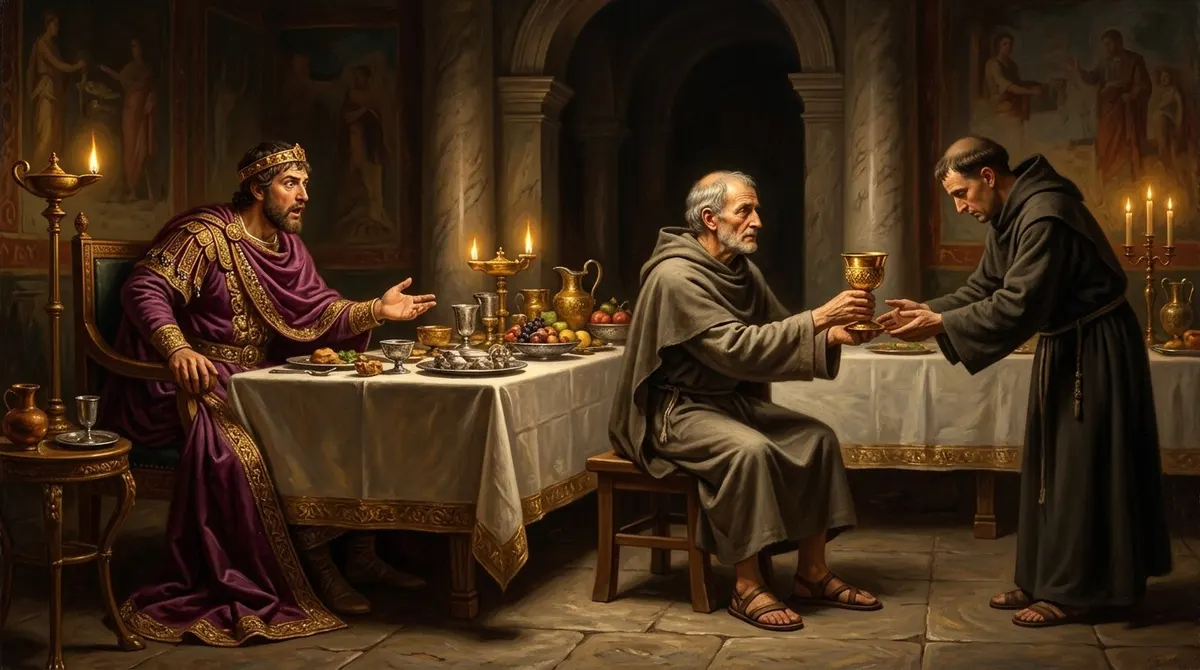
One smaller refusal belongs to the same court (Life, ch. 20). For a long time Martin would not eat at the table of Maximus, a man who had taken one emperor’s throne and another’s life. When he finally accepted, a servant brought the cup to the emperor, who had it passed to Martin first, expecting to receive it back from the bishop’s hand. Martin drank and handed it to his own priest.
The other bishops at court, Sulpicius writes, flattered the emperor; Martin alone “commanded rather than asked”. That is a biographer’s portrait, and Sulpicius had his own quarrel with the bishops of Gaul. But what lies under it is plain enough. Martin told a commander he would not fight, and told an emperor that he had no business killing people over doctrine.
Keep reading
Martin in art →Patron of what? →Fact or legend? →After the book → Get the book, free
Sources: Sulpicius Severus, Life of Saint Martin, ch. 4 and 20; Chronicle II, 46–51; Dialogues III, 11–13. Quotations follow the 1894 English translation by Alexander Roberts, in modern wording. Sulpicius is almost the only source for these events. Found a mistake? Tell us