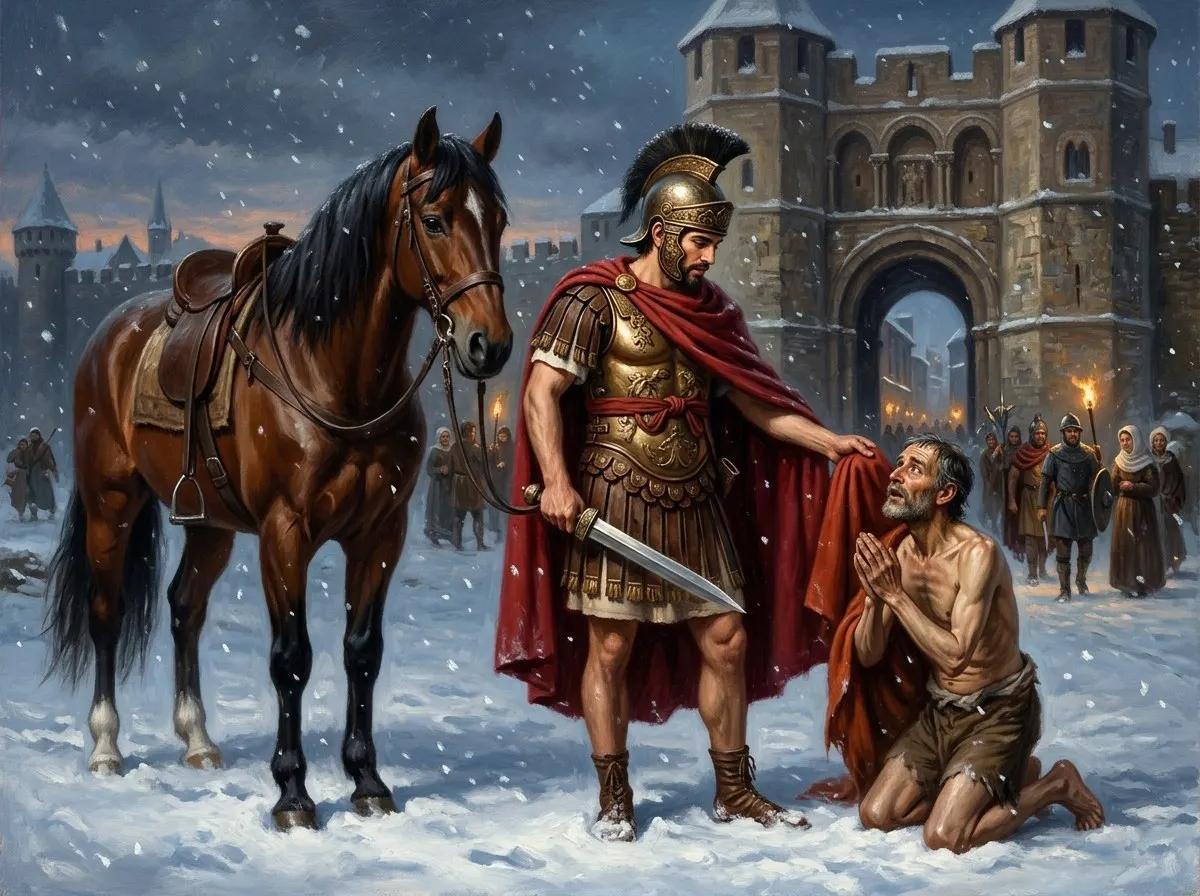
No decree made Martin the patron of most of these. People and places adopted him over the centuries, usually for a reason found in his story, sometimes for a reason nobody wrote down.
People and trades
-
Beggars and the poor
From the scene at Amiens. He is traditionally invoked by those who have nothing.
-
Soldiers, horses and riders
He was a soldier in a mounted unit before he was anything else.
-
Tailors and cloth-workers
Because of the cloak, and the cut.
-
Winemakers
His feast falls when the new wine is first tasted. A legend adds that his donkey once ate the shoots off a vine and that the vine bore better grapes the next year, which is how pruning was discovered. The legend has no early source.
-
Innkeepers
A traditional patronage, probably by way of the new wine and his constant travelling. Nobody recorded the reason.
-
Geese
From the later legend of the geese that gave away his hiding place, and from the goose eaten on his day.
-
The Pontifical Swiss Guard
In 2017 Pope Francis named Martin, Sebastian and Nicholas of Flüe as the patrons of the Guard. Its chapel in the Vatican, built in 1568, is dedicated to Saints Martin and Sebastian.
-
The French police
Chosen in 1993, at the request of a Catholic police association.
-
Army quartermasters
The supply service of the French armed forces keeps his feast, and the United States Army Quartermaster Corps has awarded an Order of Saint Martin since 1997. Handing out clothing is the job.
-
The Martins
The Church Lads’ and Church Girls’ Brigade, an Anglican youth organisation, has Martin as its patron and calls its youngest section, for children of five to seven, the Martins.
Cities
Tours, where he is buried, comes first. Szombathely in Hungary honours him as the place of his birth. The cathedrals of Mainz, Utrecht, Lucca, Ourense and Bratislava are dedicated to him, and the abbey of Pannonhalma in Hungary has carried his name since 996.
Utrecht’s red and white shield is said to recall the cloak cut in two; historians doubt it. Buenos Aires has had him as patron since 1580. The story goes that the town council drew a saint’s name from slips of paper, got Martin, objected that he was a French saint, drew again, and got Martin again. A historian of the city calls the story impossible to verify.
France
The Frankish kings, from Clovis on, treated Martin as their protector and kept his cloak as a relic. He is traditionally called a patron of France, although Rome never declared him one.
More than 200 French communes are named Saint-Martin, more than for any other saint. Several thousand churches are dedicated to him; the figure usually given is around 3,600, though nobody seems to have counted. Martin is also the most common surname in France.
San Martín Caballero
In Mexico and other parts of Latin America he is “Saint Martin the Horseman”, after the way he is painted. Shopkeepers keep his picture near the till as a helper of trade. This is a folk devotion: the Church does not approve of using him as a lucky charm.
Keep reading
Martin in art →The man who said no →Fact or legend? →After the book → Get the book, free
Patronages are traditional unless a date is given. Sources include the Holy See (address of Pope Francis to the Swiss Guard, 6 May 2017), the French Ministry of the Armed Forces, the United States Army Quartermaster Corps, the Church Lads’ and Church Girls’ Brigade and the city of Buenos Aires. Found a mistake? Tell us